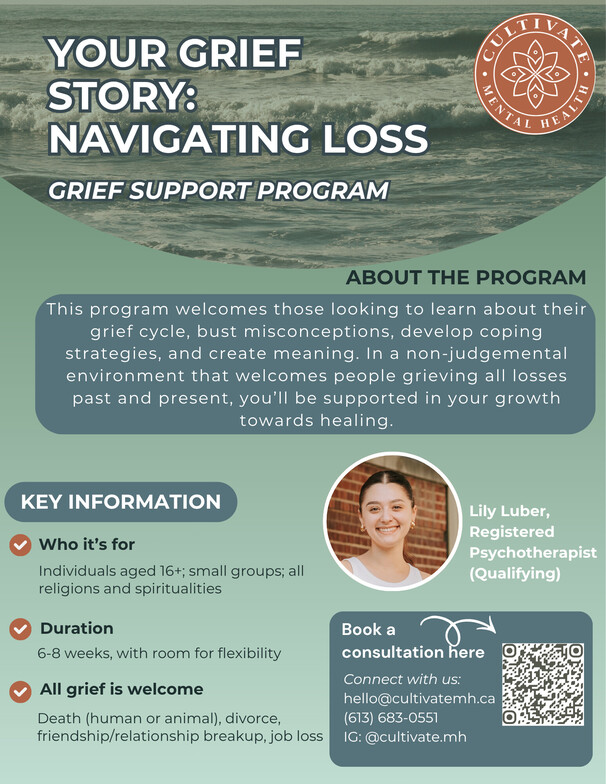
“So… what’s a grief support program?”
Our admin Kathy and I thought it might be helpful for me to answer some common grief-related questions for anyone who’s interested in my grief support program. So, hi! My name is Lily, I’m a Registered Psychotherapy (Qualifying), and I’ve got a lot to say about grief. If you’re interested in my grief support program and want a snippet of what talking about grief with me might look like, take a look at the important questions Kathy asked me below!
What are some common responses to grief?
- From popular culture, I think most people would expect a “typical” grief response to be mostly sadness, and lots of crying. While this can definitely be the case for many people, grief can also look super different between different people, cultures, and experiences! For example, some people may experience physical responses like weakness, disconnection from their environment, stomach issues and more. Additionally, people may experience changes in their appetite and sleep, act aggressively or find themselves returning to places that remind them of their loss. As for emotions, while sadness, numbness and denial may be expected, people also often experience relief. All of the above and more can be considered very normal. There is not one way to grieve.
What are some common grief misconceptions?
- I could go all day with this one! First of all, a big misconception is that you must go through all the Kübler-Ross stages of grief (in order!) from denial, to anger, to bargaining, to depression, to acceptance. While these stages can be super validating and are frequently experienced, continued research on grief has revealed that this cycle isn’t so linear, and may skip or even add some steps! Another big misconception I’d like to break down is that you shouldn’t talk to people about their grief, because maybe it’ll make them too sad or overwhelmed. Grief can be so lonely, and while experiencing and talking about grief can be a lot to deal with, avoiding talking to people about it may not help the ways you think it will. I recommend asking people how they’d like to be supported: Maybe they need a listening ear, or maybe they just need help doing their laundry. Everyone grieves differently, which may result in many misconceptions about grief, but that doesn’t mean we can’t undo this learning.
What are some self-care tools you would recommend to someone dealing with grief?
- Much like how the experience of grief can be different person to person, the ways people cope may differ as well! I believe community support is crucial: Whether that’s friends, family, religious communities or local/online bereavement groups, the impact of grief can be lessened when it’s shared. Personally, and within my own therapy approach, I’m super big on self-compassion: Since we misunderstand grief so often, and grief often involves a lot of big changes to our lives, it can be easy to get caught up in all the ways we’re “falling behind” or “not doing things right” or “not getting over it quick enough”. These ways of thinking promote shame instead of healing, which is what we should be focusing on when grieving! I’m a big fan of this exercise that asks you to talk to yourself about your struggles as if you were a friend (that’s usually an easier place to start when trying to work on self-compassion).
Why did you decide to specialize in grief counselling?
- I’m choosing to do grief work in part because it’s unavoidable (which, I know, sounds pretty pessimistic… I’m sorry!). I believe grief to be one of the most universal human experiences that all of us, client and therapist alike, will experience. Especially for clinicians, just because a client doesn’t come to us to talk about grief specifically doesn’t mean it’ll never show up over the course of therapy. It may sound obvious that talking about what hurts us helps, but with grief, I think the more we talk about it and explore it the better off we all are! Meaning making, or the rebuilding life after a loss by integrating it into your life story, is a crucial part of the grief counselling process, and talking to people about grief has been a very meaningful experience for me
Like I said at the start, I could talk about grief all day. If you feel similarly to me, or maybe if you feel a pull to talk about grief and don’t know where to start, please feel free to reach out and see if my grief support program is a good fit for you. If you would like to explore your grief together, I invite you to book a free consultation with me. No matter where you’re at in your grief story, I would be so honoured to be part of it.

.jpg)
.jpg)